Paperboard berry tray outperforms PET and rPET in carbon footprint study

Sustainability
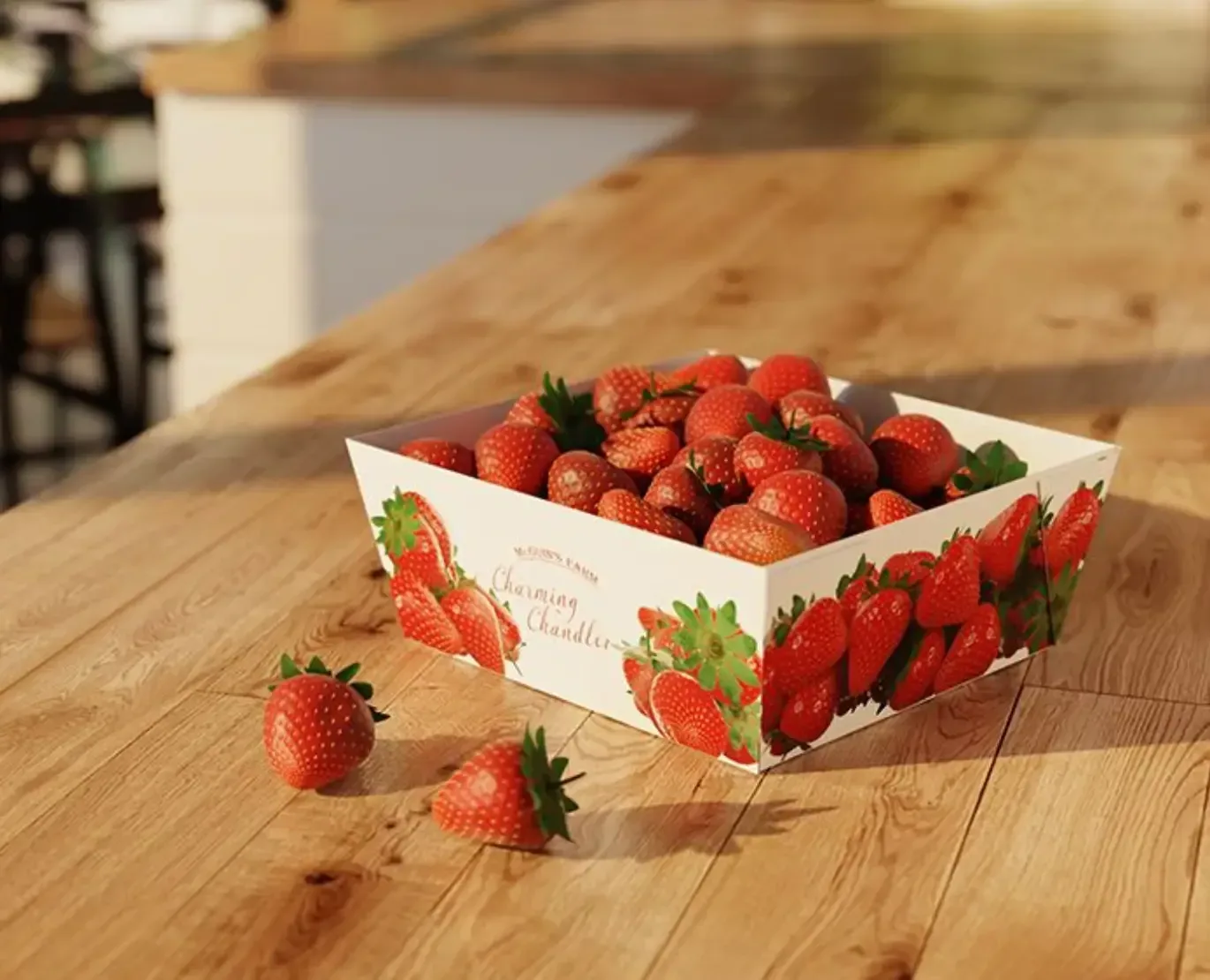
Metsä Board’s latest verified carbon footprint case study* compared berry trays made of Metsä Board’s dispersion barrier board to trays made of PET plastics.
Metsä Board’s recent comparative life cycle assessment* compared the carbon footprint of berry trays made from three different materials: MetsäBoard Prime FBB EB, PET and recycled R-PET. The study included both biogenic carbon sequestration and biogenic carbon emissions, and it was verified by two independent reviewers from RISE and SimaPro UK. The cradle-to-grave study covered multiple end-of-life scenarios, such as regional recycling and full incineration.
Under the European end-of-life scenario**, the carbon footprint of a berry tray made of MetsäBoard Prime FBB EB was shown to be negative for the studied life cycle – meaning that more carbon, expressed as CO₂ equivalents, was bound in the paperboard’s fibres than was released during the processes of the first life cycle. The carbon footprint of the PET tray was 0.071 kg CO2e, and for the R-PET tray 0.039 kg CO2e. When the end-of-life scenario was 100% incineration, the carbon footprint of a berry tray made of MetsäBoard Prime FBB EB was 87% lower than that of a tray made of R-PET.
Lari Oksala, Sustainability Manager at Metsä Board, said: When comparing end-of-life impacts, both PET plastic and paperboard contain carbon, which forms carbon dioxide during incineration. The key difference is that paperboard’s emissions are balanced by the carbon dioxide absorbed from the atmosphere during tree growth, while fossil-based plastics add new carbon to the atmosphere. The recycling rate of paperboard packaging is higher than that of plastic packaging in Europe, and recycling delays carbon release from the packaging material. According to the latest Eurostat data, as much as 87% of paper and cardboard packaging was recycled in the EU in 2023, whereas the corresponding figure for plastic packaging was 42%.***
Marjo Halonen, VP Marketing, Communications and Sustainability at Metsä Board, said: The highest total carbon footprint benefit is achieved when the packaging fulfills its primary function to protect the product inside. The packaging material must always be tested and selected according to the intended application. Our lightweight, fresh fibre paperboards are produced mainly with fossil-free energy, which further reduces the climate impact. Metsä Board is advancing towards its ambition of phasing out the use of fossil energy in its mills by 2030.
*) The study was performed in accordance with ISO 14040, ISO 14044 and ISO 14067. The functional unit was a berry tray that met the necessary properties of stiffness, functionality, and moisture resistance. The selected system boundary for the study was cradle-to-grave and the selected climate change impact methodology was IPCC 2021 Climate Change: Total (incl. biogenic CO2). Climate change impacts for competing materials utilises data from Ecoinvent 3.10. The technical background report and the 3rd party verification statement are available on Metsä Board’s website.
**) Eurostat 2021. The recycling rate for paper and cardboard packaging was 82.5%, and for plastic packaging 40.7%. Of the material that remained unrecycled, it was assumed that 56% was incinerated and 46% ended up in landfill, in accordance with municipal waste statistics.”
***) Eurostat 2023: https://ec.europa.eu/eurostat/databrowser/view/env_waspacr/default/table?lang=en
This article was originally published by Metsä Board/Cision.
Related News
-
Supplier News
Tadbik’s Fresh Lid helps extend the shelf life of fresh produce
-
Supplier News
Radnor Hills launches Disney-themed Radnor Fruits range in Tetra Pak cartons
-
Business
New packaging solution prevents waste and damage in long-haul fruit & veg exports
-
Sustainability
Retailer replaces plastic with cardboard punnets for Belgian strawberries
-
Sustainability
Compostable and recyclable: Starbucks redesigns its iconic white takeaway cup
Latest Packaging News

Barrel-shaped packaging introduced for bourbon-inspired dog treats
Holladay Distillery has introduced barrel-shaped packaging for its new Bourbones dog treats,...
Corona Cero introduces seven-bottle pack inspired by days of the week
A new seven-bottle packaging format has been developed for Corona Cero, the alcohol-free beer brand...
Paramount Packaging Systems gives UK manufacturers first look at FUJI Alpha X
Paramount Packaging Systems, the exclusive UK and Ireland distributor of FUJI flow wrapping...
PHS: A practical guide to buying industrial pallet wrapping machines in the UK
The fastest pallet wrapper is not necessarily the right one for your operation. An industrial...