The new CanPal from Craemer – the robust pallet that can handle cans

Supplier News
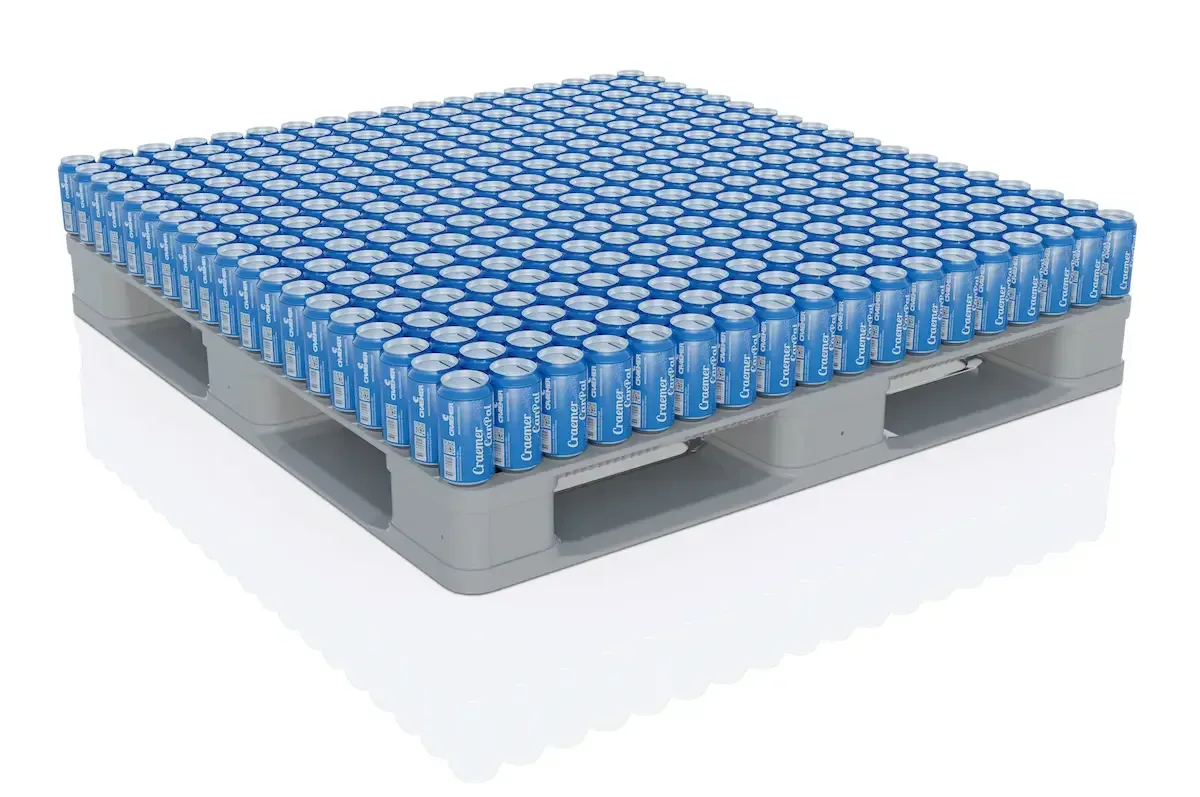
Reliable load carriers are essential for producing, filling, storing and transporting beverage cans. The industry predominantly relies on pallets with special dimensions that are precisely tailored to its requirements – whether for can manufacturing, beverage production, logistics centres or export. These industry-specific solutions are precisely adapted to the stacking dimensions, conveyor lines and lorry loading patterns of the beverage industry and play a central role along the entire process chain. The Craemer Group, a leading global manufacturer of durable logistics solutions, is launching the new “CanPal German” plastic pallet. This innovative, patented product offers an exceptionally robust pallet block design for the safe and sustainable transport of cans. This traditional, family-run company specialises in metal forming, plastics processing and tool making. Based in Herzebrock-Clarholz, Germany, it will be presenting its new CanPal German pallet for the first time at the interpack 2026 trade fair.
The Craemer Group has almost 70 years of experience in manufacturing plastic products. As early as 1958, the company added plastics processing to its metal forming business. Initially, Craemer manufactured large plastic injection-mould containers. In 1967, the company developed the world's first one-piece injection-moulded plastic pallet. Today, the portfolio comprises plastic pallets for various requirements and a wide range of transport and storage containers – from stacking boxes, round containers and tubs to pallet boxes. All Craemer plastic products are made from high-quality, durable, recyclable plastics to ensure maximum stability and a long service life.
In addition to the modern production facilities, an in-house technology centre unites research & development and toolmaking under one roof, ensuring consistently high quality. Thanks to their sophisticated design, Craemer plastic pallets are highly functional and ideal for intensive use. Craemer can also provide customised solutions to meet individual requirements.
Technically sophisticated in every detail
The base body of the Craemer CanPal has external dimensions of 1250 x 1180 x 133 mm – with optional spacers, its dimensions are 1265 x 1180 mm. To provide even greater protection and stability when securing loads — particularly when using strapping tapes — Craemer has specially reinforced the lower edge of the upper deck above the entry openings with ribbing. The pallet is made from robust polypropylene (PP), ensuring extra robustness: this material is durable and resistant, has a tare weight of only 22.5 kilograms and is 100 % recyclable. The new Craemer can pallet has a load capacity of up to 10000 kg for static loads and up to 1250 kg for dynamic loads.
Optimised design for maximum stability
The Craemer CanPal is the result of extensive research and development. Although the new pallet is designed as a multi-part system in line with industry standards, it has significant advantages over conventional models. Rather than using a single-piece injection-moulding process, it is deliberately made up of two parts – an upper part and a lower part – that are firmly connected to each other. The Craemer experts have specifically optimised the known weak points of multi-part pallets. For example, the connection between the upper and lower decks in the area of the blocks is usually highly susceptible to breakage when falling from a great height or colliding with forklift tines, but this has been specifically counteracted. Despite its multi-part construction, the design ensures an extremely stable unit that is by no means inferior to a single-piece solution.
Sophisticated design thanks to simulation
The design of the new pallet for all types of cans is based on a sophisticated investigatory process. Craemer's designers used cutting-edge simulation methods to analyse and optimise the geometry of the runners and deck. Finite element modelling (FEM) is a virtual method of analysing strength and deformation. FEM allows to simulate physical reality without the effort, time or risk involved in creating real prototypes. The result is a pallet that strikes the perfect balance between functionality – with robust and rigid runners and a matching deck – and carefully thought-out design.
Patented manufacturing process
The design of the CanPal is based on Craemer's patented manufacturing process, which involves inseparably connecting the upper deck and runners. The result is an extremely robust construction which is as stable as a one-piece pallet, and which far surpasses conventional multi-piece systems. The pallet blocks retain their shape and function even under high loads, impact or deformation. The result is significantly increased break resistance and a long service life, which are both essential factors for cost-effectiveness and sustainability in everyday use.
Flexible equipment as required
Optional spacers on the lower edge of the outer blocks on the long sides of the pallets prevent them from touching each other when stacked and held together by protruding pallet collars or interlayers. To improve slip resistance of picked up pallets or while the load is lifted by forklift tines, four Palgrip® anti-slip clips can be retrofitted to each of the CanPal's upper and lower decks. Retrofitting with transponders is also optional: To this end, there are two diagonally opposite slots in the upper deck, above the outer right blocks on the long sides, that can hold Smartrac Dogbone RFID inlays. Moreover, the outer blocks on the long sides provide space for hot stamping of lettering or logos. The CanPal German pallet is available in the standard colour of light grey (other colours available on request). It also impresses with its high temperature resistance, which ranges from –30 °C to +40 °C, and even up to +90 °C for short periods.
Craemer Group at the interpack 2026 fair
The CanPal German Pallet is set to make its debut at interpack 2026, an international trade fair showcasing the latest innovations in the packaging and related process industries. From 7 to 13 May 2026, the Craemer Group will present its innovative can pallet to a broad specialist audience for the first time in Düsseldorf.
The Germany-based Craemer Group is an international family-run company specializing in the core businesses of metal forming, plastics processing and tool making. Craemer GmbH was founded in Herzebrock-Clarholz in 1912. The Craemer Group has three additional production sites in Europe and a global network of its own sales offices and partners. In 2024, Craemer generated a total operating performance of approx. 360 million euros with around 1,100 employees in all three business fields.

Related News
-
Supplier News
Craemer CB3 High pallet box for efficient biodegradable waste logistics
-
Supplier News
Craemer CB3 pallet boxes support municipal WEEE collection in Germany
-
Supplier News
Craemer Group: CB3 High pallet box for efficient biodegradable waste logistics
-
Supplier News
Craemer Group: CB3 Low – the new, compact pallet box for efficient handling
-
Supplier News
Craemer Group: No new plastic – Zero Virgin from used products
Latest Packaging News

Conference programme to tackle sustainability, regulation and innovation at UKPackaging Expo
UKPackaging Expo will put insight, regulation and real-world best practice centre stage this...
PCR and PPWR: Be ready for the 2027 gardening season with PEKU Folien!
As one gardening season comes to an end, preparations for the next are already underway. Whether...
SUPER DRY: How El Niño could affect global shipping and moisture risk
El Niño can affect more than rainfall and temperature. It can also change the conditions cargo...
Waitrose refreshes Good Health logo with new packaging labelling standards
Waitrose has announced changes to its Good Health logo, introducing additional ingredient...