Keep it moving, keep it dry: SUPER DRY moisture protection for global electronics industry

Supplier News
Corrosion can easily occur on electronic components without sufficient moisture control.
By the beginning of 2026, electronics exports from Southeast Asia had grown by around 25%, with South Asia recording a 36% increase. As production gradually shifts southwards, electronics manufacturers face a challenge that is easy to underestimate: tropical climates with high humidity and temperatures threaten sensitive components throughout production, storage and transit.
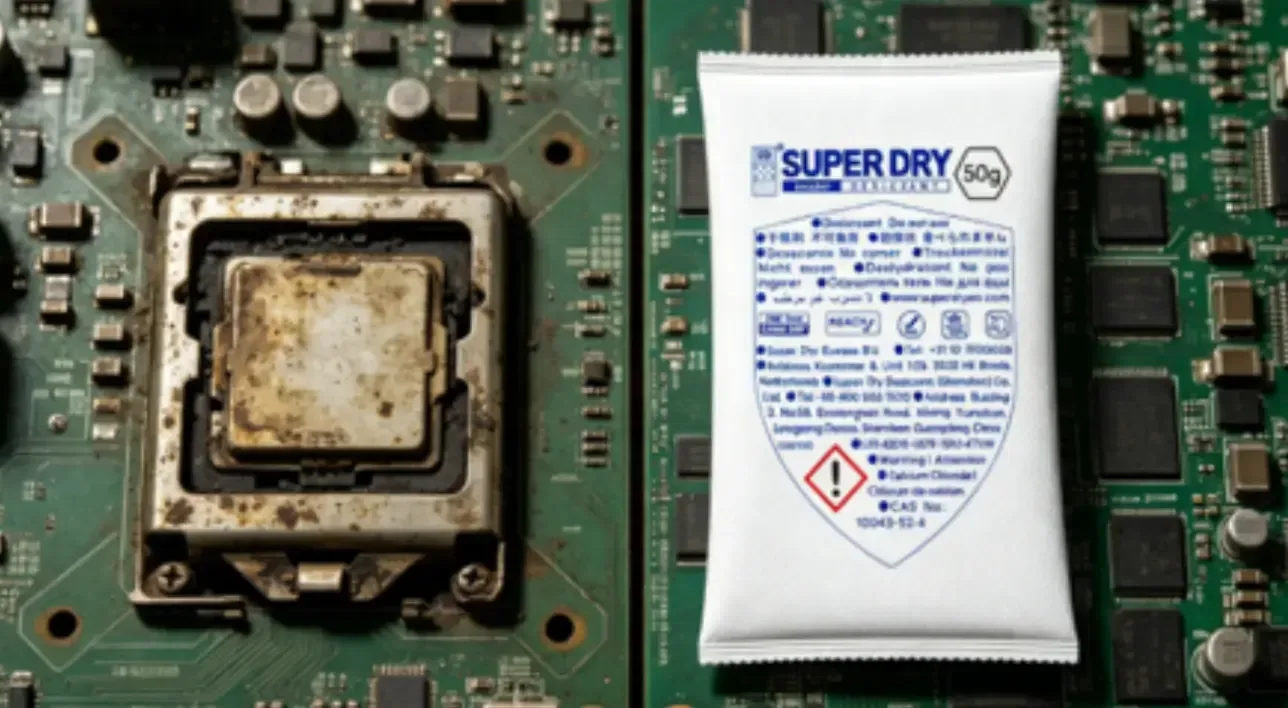
Vulnerabilities in the tropics
Relative humidity during tropical shipments typically hits 90%, while research shows that corrosion rates accelerate significantly once humidity exceeds 60%. Unprotected components can begin to corrode within 1~2 days, directly impacting product quality, customer experience and brand reputation.
Yet the core issue is not simply that tropical air is hot and humid. Modern electronics are fundamentally more vulnerable to moisture than a decade ago.
As the trend toward smaller, lighter devices has allowed precise component production, electronic devices have become increasingly prone to failures due to corrosion. When moisture films form on component surfaces, metal ions dissolve and migrate, causing short-circuit failures. This risk grows as the component size shrinks.
The cause is structural: components are developed and produced with greater precision and travel longer in high-humidity conditions during sea freight. Inconsistent moisture control at any point of electronics manufacturing, whether in a Thai factory, a Malaysian warehouse or a vessel crossing the Indian Ocean, may introduce quality risks that ripple across the supply chain.
A decade-long partnership
Premium calcium chloride desiccants have become a popular choice for moisture control during sea freight. They are engineered with an absorption rate of 300% in hot, humid tropical environments, compared with only 20~30% for silica gel and clay. A protection window of approximately 90 days maintains a stable low-humidity microenvironment across logistics chains.
For over 10 years, a leading display panel manufacturer has relied on calcium chloride desiccants to protect its extended supply network across Southeast and South Asia.
Among all solutions, SUPER DRY desiccant is a pioneer in moisture prevention. In addition to outstanding performance, the calcium chloride desiccant with double-layer packaging eliminates the risk of leakage or contamination, providing a safeguard for precision electronics while minimising environmental impact to water and soil.
SUPER DRY’s logistics infrastructure supports delivery within 3 hours. R&D-driven customisation further optimises desiccant deployment without compromising performance.
SUPER DRY delivers professional solutions that help the electronics industry turn environmental vulnerability into a source of operational confidence in product quality, supply chain resilience and long-term brand reliability.
To protect your shipments with desiccants recognised by world-leading businesses, contact the team.
This article was originally published by SUPER DRY.

Related News
-
Supplier News
Clean and dry, every time: How SUPER DRY helps protect premium egg quality
-
Supplier News
SUPER DRY: How El Niño could affect global shipping and moisture risk
-
Supplier News
Smart moisture protection for PPWR: SUPER DRY supports compliance with new EU regulations
-
Supplier News
SUPER DRY: Dry with standards – why ISO-certified desiccant is smarter for supply chain
-
Supplier News
SUPER DRY: Pack smart, stay compliant – What PPWR Means for businesses targeting the EU?
Latest Packaging News

Registration now open for Packaging Innovations & Empack 2027
The UK packaging and processing community will return to the NEC Birmingham on 24 & 25...
Clean and dry, every time: How SUPER DRY helps protect premium egg quality
For high-quality egg suppliers, appearance matters. Even minor shell or quality defects can affect...
Rowlinson Packaging: The hidden cost of product damage and why industrial packaging matters
For many businesses, packaging is often viewed as a procurement decision focused primarily on cost....
Autopack: What is a sealing machine and how does it work?
A sealing machine closes packaging after a product has been filled or packed. Depending on the...