July US packaging update: Date labels, foam bans and EPR changes
Business
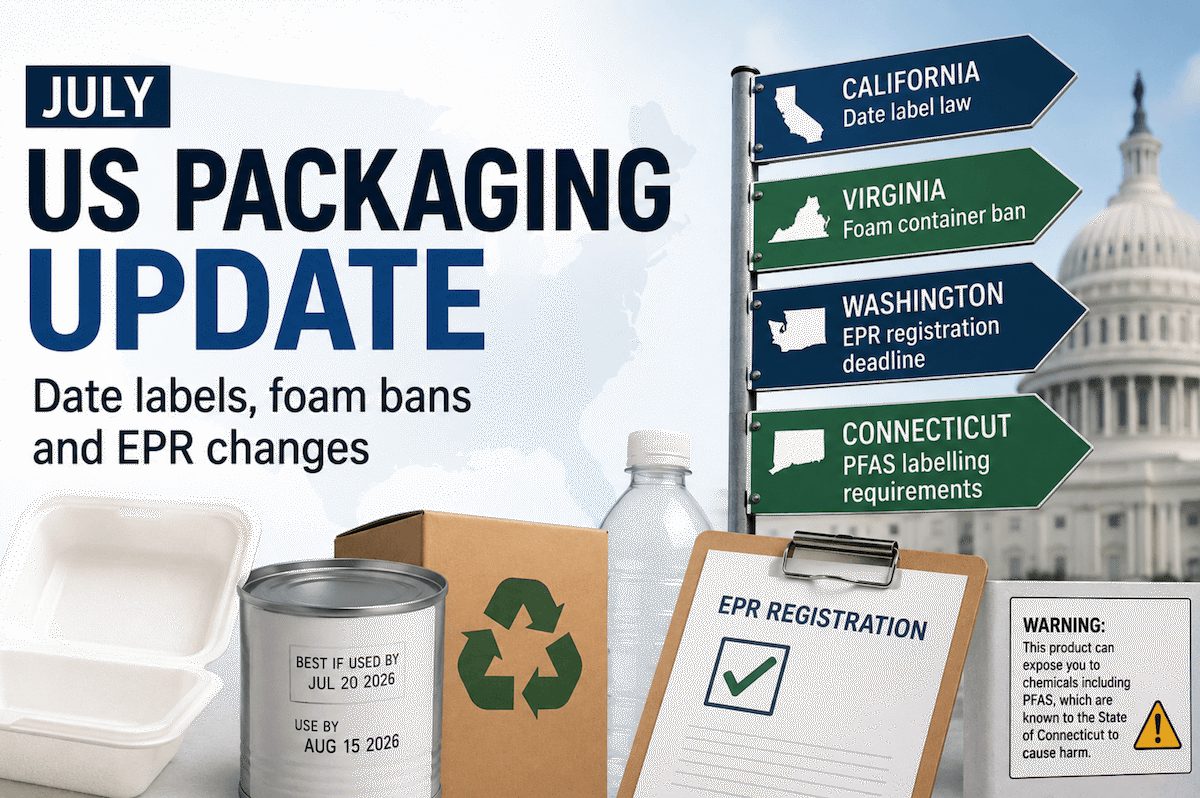
From California's standardised date labels to Virginia's expanded foam ban and Washington's EPR deadline, this round-up highlights the latest packaging policy developments across the United States.
California standardises food date labels
In California, new food date labelling rules came into effect on 1 July 2026 under AB 660. The law prohibits consumer-facing “sell by” dates on most food products and requires standardised wording for quality and safety dates, including “best if used by”, “best if frozen by”, “use by” and “use or freeze by”. Eggs and infant formula are exempt. The measure is intended to reduce consumer confusion and help cut food waste.
Virginia expands foam food container ban
Virginia has also expanded its ban on expanded polystyrene foodservice containers. From 1 July 2026, all food vendors in the state, including restaurants, grocery stores, food trucks, caterers and schools, must stop using EPS foam food containers. Larger vendors with 20 or more Virginia locations were already covered from July 2025, with the latest phase extending the requirement to remaining food vendors.
Washington reaches EPR registration deadline
In Washington, packaging producers faced a 1 July 2026 deadline to register with a producer responsibility organisation under the state’s packaging extended producer responsibility programme. Circular Action Alliance has been designated as the PRO for Washington, with producers required to register with a PRO or register as a PRO implementing an individual plan.
Connecticut introduces new PFAS labelling requirements
From 1 July, manufacturers selling certain products containing intentionally added PFAS in Connecticut must provide notification to the state and apply approved warning labels. The measure forms part of wider legislation introduced in 2024 that will eventually prohibit the sale of many PFAS-containing products from 2028. While the requirements apply to a broad range of consumer goods, they also reflect the continued expansion of state-level regulation surrounding chemicals used in packaging and food-contact materials.
In other news...
California plastic law faces legal challenge
A coalition of 17 states has filed a federal lawsuit challenging California's landmark plastic reduction law (SB 54), arguing that it places an unfair burden on out-of-state businesses and conflicts with interstate commerce rules. The legal action comes as California continues implementing one of the most ambitious packaging and plastic waste reduction frameworks in the US.
State packaging policy continues to evolve
Beyond July's compliance milestones, several states continue to advance packaging legislation covering extended producer responsibility (EPR), recycled content, PFAS restrictions and recyclability labelling. Industry organisations say businesses operating across multiple states should continue monitoring developments closely as packaging regulation becomes increasingly fragmented across the US.
Together, these developments reflect a broader shift in US packaging policy, with state-level measures increasingly focusing on recyclability, foam packaging, food waste, PFAS and producer responsibility. Businesses operating across multiple states are likely to face growing pressure to monitor evolving requirements as implementation timelines continue to advance.
Related News
-
Business
US lawmakers reintroduce bill targeting chemicals used in food packaging
-
Sustainability
Synthetic compostable packaging excluded from USDA organic standards
-
Business
good2grow launches limited-edition bottles featuring US landmarks
-
Business
Lavazza brings capsule-free coffee tabs to US market
-
Supplier News
US packaging facility expands with Aopack BM3000-HD box making machines
Advertisement

Latest Packaging News

Grated cheese goes pocket-sized with limited-edition clip-on packaging
Kraft Natural Cheese has introduced Pocket Parm™, a limited-edition miniature version of its grated...
Truly Grass Fed updates packaging in response to consumer preferences
Truly Grass Fed has introduced a refreshed packaging design across its dairy product range, with a...
Miron® introduces refreshed brand identity and website
A new digital experience brings protective glass packaging, expertise, and inspiration together...
Raft of new exhibitors completes the UKPackaging EXPO 2026 line-up
A surge of newly confirmed exhibitors has finalised the floor plan for the highly anticipated...