Bandall success story: Lisner cuts 400 tonnes of plastic with switch to paper banding

Supplier News
Quality products, inefficient packaging
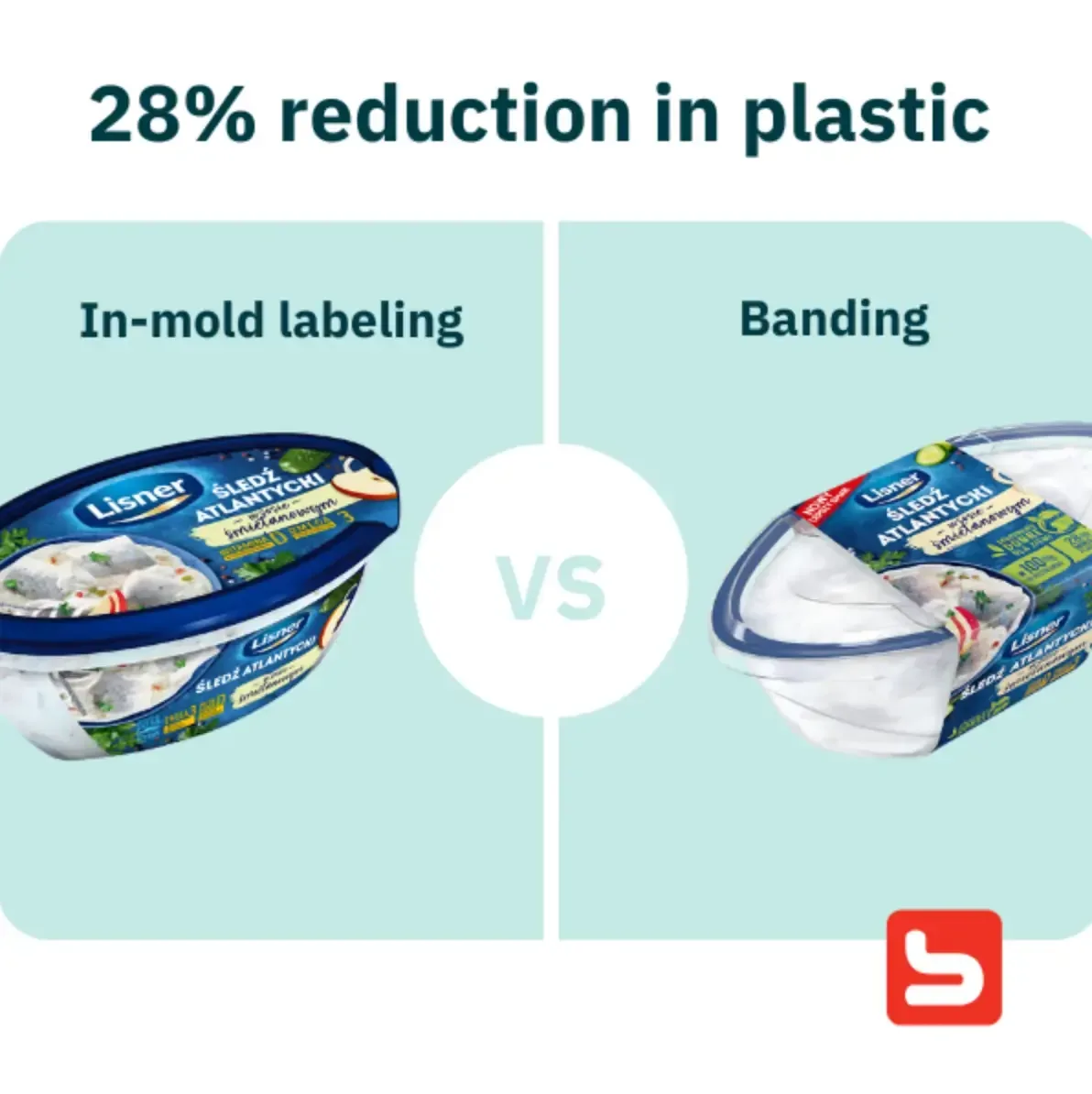
Lisner, a leading name in herring preparations, salads, and sandwich spreads in Poland, is known for its dedication to quality and efficiency. Delivering fresh products across Europe requires not just great recipes but also efficient packaging. For years, Lisner used in-mold labeling (IML) on polypropylene tubs for branding and labeling, however, this method had a major drawback. Their packaging was heavier than what they would have wanted, resulting in high expenses.
Lisner chooses banding
Lisner knew a better option was out there. As they started their journey looking for a better alternative, they recalled seeing and hearing about banding at trade fairs. Intrigued by its potential, they turned to Voltapak, Bandall’s distributor in Poland, to see if banding could solve their problem.
To see banding in action, Lisner invited Bandall for an on-site demonstration. They tested how bands would look on various products, with a particular focus on their herring products. The results were impressive. Banding proved to be a perfect match for Lisner’s transparent tubs.
The sleek band covered only a small portion of the packaging, allowing for greater visibility of the product inside. At the same time, it offered a unique space for branding, enhancing the product’s appearance. The thin film band added little to no extra weight, creating a secure seal while fully supporting Lisner’s goal of using lighter, more sustainable packaging materials. Additionally, because no adhesives were used, the band could be easily removed and recycled.
The choice was clear: Lisner decided to replace in-mold labels with sleek film banding material and began integrating Bandall’s automated banding machines into their operations. However, while selecting the solution was easy, implementing it came with challenges...
Overcoming challenges
Meeting high-speed packaging demands
The first major challenge was achieving the required packaging speed. Given Lisner’s large-scale operations, they needed machines capable of packaging 120 herring products per minute. However, a single automated banding machine typically handles only 20-30 products per minute. This was far below the required output.
To bridge this gap, Bandall’s engineers developed a custom solution. Instead of using individual machines, they custom designed automated TRC banding machines with multiple banding heads. This innovation allowed multiple products to be banded simultaneously, ensuring that Lisner’s production speed target was met.
However, while this solution addressed the speed challenge, it introduced a second challenge: space constraints.
Integrating larger machines in a limited space
The implementation of multiple TRC banding machines required significantly more floor space than the previous setup. To accommodate them, Lisner had to expand their production site and carefully plan for the necessary adjustments. This process took time and added complexity to the transition.
Once the machines were installed and operations began, Lisner faced an unexpected third challenge: machine malfunctions.
Preventing machine malfunctions
Shortly after Lisner launched their banding process, an unexpected issue brought production to a halt. Their machines had stopped working. The cause? Oils and grease from the herring products were accumulating inside the machines. This was a unique challenge Bandall had never encountered before.
But rather than stepping back, Bandall stepped up. Determined to help Lisner succeed, Bandall quickly identified the problem and provided a practical solution. To minimize downtime and keep operations running smoothly, regular cleaning was introduced as a key part of the process.
To support Lisner’s team, Bandall’s engineers delivered on-site workshops showing exactly how to disassemble, clean, and reassemble the equipment with confidence and efficiency.
With these maintenance protocols in place, Lisner was able to maintain high productivity while preventing further disruptions.
Lighter packaging, cost savings, and a future proof solution achieved
Lisner’s transition to banding marked a significant step toward a more cost-effective and sustainable future. By adopting this innovative solution and overcoming implementation challenges, they have enhanced product appeal, reduced their environmental footprint, and saved substantial amounts of material and costs.
With 66 million herring products successfully banded and considerable reductions in material usage, Lisner has proven that large-scale packaging can be both practical and environmentally responsible. Their success serves as an inspiring example for the food industry, demonstrating that sustainability and efficiency can go hand in hand and encouraging other companies to explore greener packaging solutions.
This story was originally published by Bandall.

Related News
-
Supplier News
Bandall: Linerless labeling for ready meals – An alternative to adhesive labels
-
Supplier News
Bandall: How printing companies can bundle more efficiently
-
Supplier News
Bandall: 5 reasons to use banding for skin packaging
-
Supplier News
Bandall: A smarter way to label meat packaging
-
Supplier News
Bandall: Banding vs labels or stickers – which offers better tamper-evident packaging?
Latest Packaging News

Grated cheese goes pocket-sized with limited-edition clip-on packaging
Kraft Natural Cheese has introduced Pocket Parm™, a limited-edition miniature version of its grated...
Truly Grass Fed updates packaging in response to consumer preferences
Truly Grass Fed has introduced a refreshed packaging design across its dairy product range, with a...
Miron® introduces refreshed brand identity and website
A new digital experience brings protective glass packaging, expertise, and inspiration together...
Raft of new exhibitors completes the UKPackaging EXPO 2026 line-up
A surge of newly confirmed exhibitors has finalised the floor plan for the highly anticipated...