TPC: Packaging technology and EPR – Engineering the next generation of cost-efficient sustainable packaging

Supplier News
Extended Producer Responsibility (EPR) legislation is rapidly reshaping how packaging is designed, manufactured, and evaluated across North America and Europe. As regulatory frameworks shift the economic responsibility for recycling and waste management onto producers, packaging engineers need to rethink traditional packaging formats and material use. For high-volume products, EPR can shift packaging costs by 20–50%, translating to millions in annual margin impact depending on format selection. The result is a new wave of packaging innovation in which design, sustainability, cost optimization, and operational feasibility must coexist from the inception.
At its core, EPR changes the economic equation of packaging design. Instead of considering only resin cost, logistics efficiency, and performance requirements, companies must now account for fees tied directly to the material type and weight of packaging placed on the market. Under typical fee structures, rigid plastics may be assessed at around $0.24 per kilogram, flexible plastics at around $0.34 per kilogram, and paper or fiber-based materials at roughly $0.06 per kilogram. These differences materially influence format selection, lifecycle modeling, and end-of-life recovery economics, requiring packaging to be engineered as a full system rather than a discrete component.
For many consumer and industrial products, rigid containers have historically dominated due to their durability, consumer familiarity, and compatibility with existing filling infrastructure. However, EPR economics are pushing manufacturers to analyze the full system cost of these formats. A recent engineering case study comparing multiple packaging formats for a one-gallon lubricant product illustrates how minor changes in packaging design can have measurable cost implications.
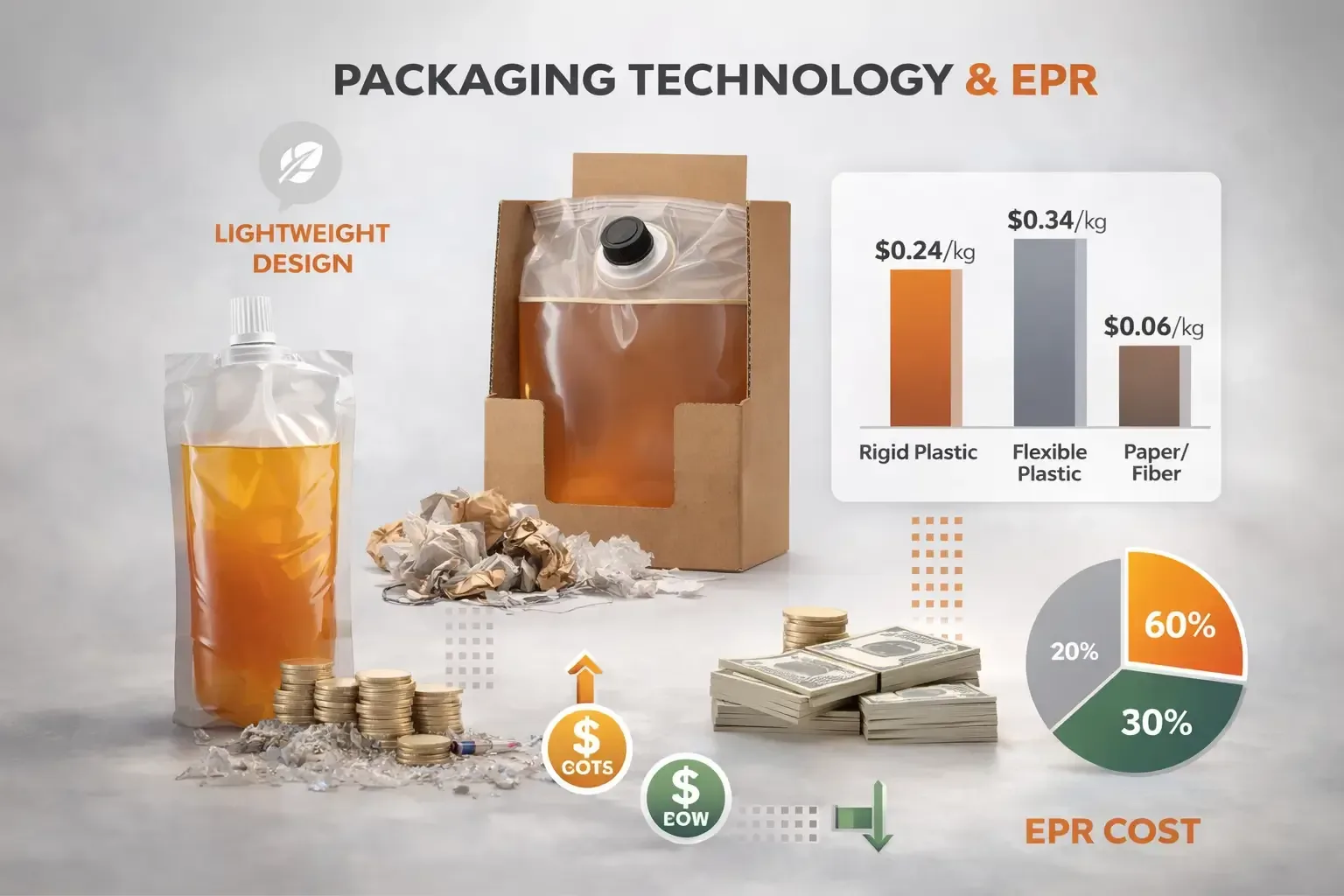
The analysis evaluated four packaging systems: the current one-gallon rigid HDPE bottle, a lightweight optimized bottle, a flexible spouted pouch, and a bag-in-box (BIB) configuration. Each choice carries a different material footprint and EPR liability. The traditional bottle design requires approximately 135 grams of plastic per gallon plus 60 grams of corrugated packaging. In contrast, a redesigned lightweight bottle reduces plastic consumption to roughly 110 grams per gallon while keeping the same secondary packaging.
Even this modest design optimization produced meaningful results. The lightweight bottle reduced estimated EPR costs by roughly 16.7 percent compared with the baseline design. More significant reductions using alternative formats like bag-in-box systems, which reduced plastic usage to approximately 60 grams per gallon and lowered EPR fees by nearly 30 percent.
However, packaging innovation rarely occurs in isolation. While formats like pouches or BIB can provide significant material savings, they also bring new technical and operational challenges. Flexible packaging often requires new equipment platforms—such as vertical form-fill-seal systems or dedicated pouch filling lines—that can insert fitments and create high-quality seals for viscous products. Although material reduction led to direct EPR savings, a system-level analysis also uncovered secondary impacts like improved pallet density, lower freight costs per unit, and potential changes in line efficiency—factors that can either enhance or offset the apparent material savings. These modified packaging systems must ensure engineering adaptability and product safety, while satisfying distribution, retail, and consumer requirements.
Bag-in-box formats similarly require new filling technologies capable of forming, filling, and sealing multilayer bags with taps or dispensing fitments. For manufacturers accustomed to rigid container lines, transitioning to these systems represents a foundational change in production flow. Capital investment for new equipment can range from $60,000 to $250,000, depending on the level of automation, throughput targets, and integration complexity.
Secondary packaging and retail presentation also play critical roles in adoption. Flexible pouches and BIB systems require redesigned corrugated packaging to maintain stacking strength and shipping stability. Additionally, consumer expectations must be addressed, particularly in product categories where rigid bottles have long been the standard.
Because of these constraints, companies are pursuing a hybrid strategy: incremental improvements to existing rigid packaging combined with selective exploration of alternative formats. Lightweighting bottles, optimizing top-load performance, and increasing product volume per container are all strategies that can deliver EPR savings without major disruptions to manufacturing infrastructure.
Another emerging pathway involves semi-rigid bottle-in-box configurations or larger multi-gallon containers. These formats reduce the plastic required per unit of product while maintaining compatibility with familiar packaging technologies.
Ultimately, EPR is accelerating the evolution of packaging engineering from a purely functional discipline into a strategic business necessity. Engineers must now evaluate packaging through a multi-dimensional lens that includes regulatory compliance, material science, manufacturing economics, and consumer acceptance. Delayed assessment and reporting under current EPR legislation introduces measurable financial and compliance risk, including retroactive fee reconciliation, penalties, and loss of favorable fee modulation status tied to recyclability claims. In several jurisdictions, late or inaccurate reporting can also trigger audits and reclassification of materials, resulting in higher fee tiers and unplanned cost exposure.
The companies that succeed will be those that integrate sustainability metrics into early-stage packaging design and leverage digital engineering, lifecycle modeling, and system-level optimization. By treating packaging as a complete system rather than a single component, organizations can reduce environmental impact while simultaneously lowering costs. Alternative formats introduce interconnected system changes across filling, sealing, distribution, and retail presentation, requiring coordinated redesign rather than isolated material substitution.
As EPR regulations expand globally, the message for the packaging industry is clear: the future belongs to designs that are lighter, smarter, and engineered with the entire lifecycle in mind. EPR is no longer a compliance exercise—it is a margin lever. Organizations that integrate packaging engineering, financial modeling, and lifecycle strategy at the design stage will unlock cost advantages that competitors cannot retrofit later.

Latest Packaging News

Grated cheese goes pocket-sized with limited-edition clip-on packaging
Kraft Natural Cheese has introduced Pocket Parm™, a limited-edition miniature version of its grated...
Truly Grass Fed updates packaging in response to consumer preferences
Truly Grass Fed has introduced a refreshed packaging design across its dairy product range, with a...
Miron® introduces refreshed brand identity and website
A new digital experience brings protective glass packaging, expertise, and inspiration together...
Raft of new exhibitors completes the UKPackaging EXPO 2026 line-up
A surge of newly confirmed exhibitors has finalised the floor plan for the highly anticipated...