AOPACK: How a short-run box making machine handles oversized corrugated orders

Supplier News
Producing an oversized corrugated box is not always technically difficult. Producing only 100 or 200 boxes economically is the real challenge.
With a conventional die-cutting workflow, every new box size or structure may require a dedicated cutting die. For a small order, the tooling cost can represent a significant part of the total order value. Long setup times and repeated handling can also make these jobs unattractive for a high-volume production line.
At Dongguan Shengda Packaging in China, an AOPACK box making machine is used to process oversized, irregular and low-volume corrugated box orders without preparing a traditional cutting die for every job.
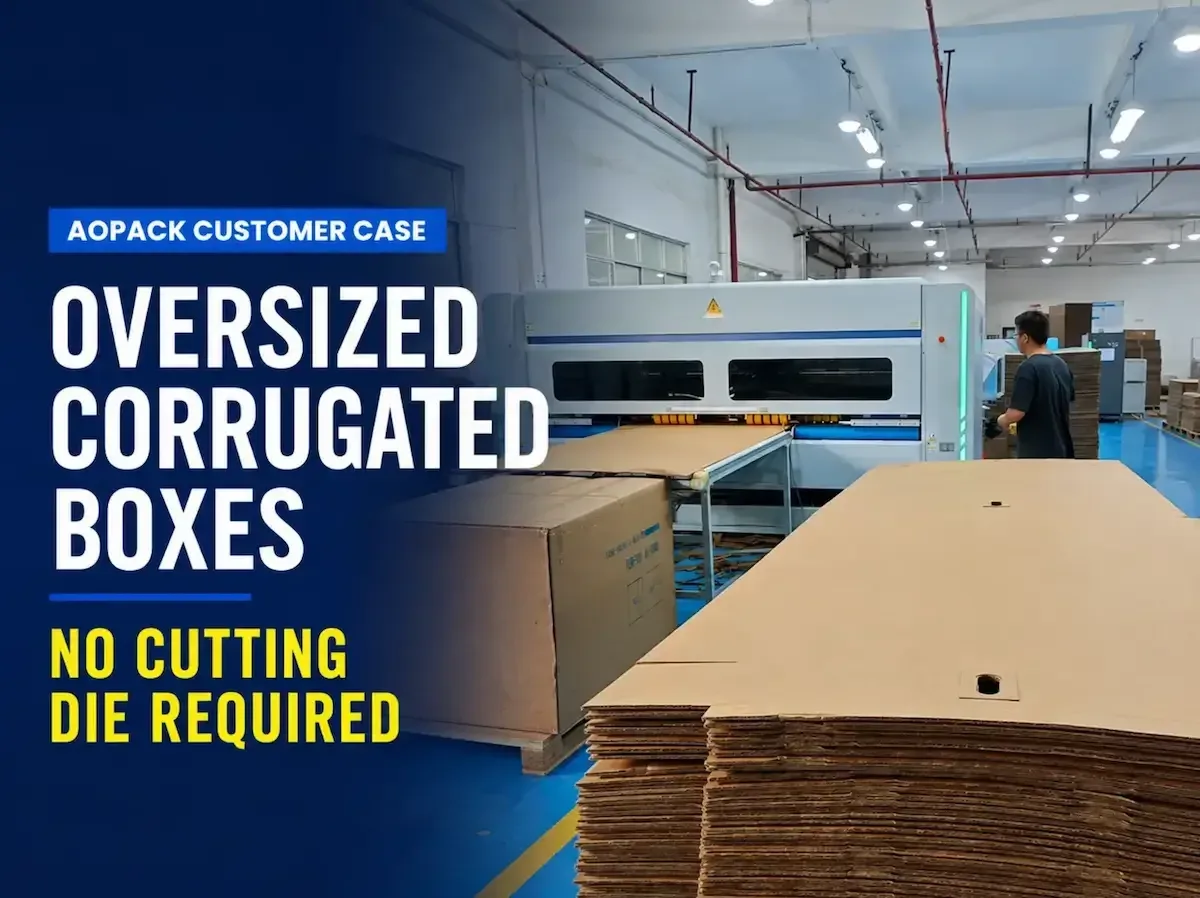
A box plant focused on oversized heavy-duty packaging
Dongguan Shengda Packaging specializes in oversized heavy-duty corrugated boxes. In the customer-site video, Mr. Xiang, the company owner, introduces a large corrugated box used for monitor packaging.
This type of packaging has two clear characteristics: the corrugated sheet has a large format, and the required quantity is relatively small. A typical order contains approximately 100 to 200 boxes.
These quantities are too small to absorb the cost of a new cutting die efficiently, but they are also large enough that manual cutting would require too much time and labour. This is where a short-run box making machine provides a practical middle ground.
Video position: Embed the Dongguan Shengda customer-site video here.
Why orders of 100–200 boxes are difficult for conventional equipment
Traditional die-cutting equipment is highly efficient when the same box is produced in large quantities. However, oversized short-run orders create a different production challenge:
- Each size or structure may require a different cutting die.
- A large-format cutting die can cost several thousand RMB.
- Setup and die preparation extend the delivery time.
- Irregular holes or cutouts may require additional processing.
- Customers may reorder regularly, but not always in the same size.
For a 100- or 200-piece order, these costs can quickly reduce the profit margin. Some box plants therefore reject the order, quote a high minimum quantity or outsource the work.
Shengda takes a different approach. It uses the AOPACK machine for large-format jobs with limited quantities, allowing the company to accept orders that are difficult to produce economically on conventional equipment.
Producing long box blanks without a cutting die
The required box dimensions and processing pattern are prepared in the machine program. The corrugated sheet then passes through the machine for the required slotting, slitting, creasing, trimming and cutting operations.
For extra-long boxes, the feeding-direction design makes it possible to process long corrugated sheets, subject to the selected machine model, board width and configuration.
Because the dimensions are controlled by the program, changing from one order to another does not require the operator to prepare and install a new cutting die. This makes the workflow better suited to short runs, changing dimensions and repeat orders with multiple specifications.
For a broader technical introduction, see how AOPACK machines can support oversized corrugated box production without traditional cutting dies.
Cutting locking holes in one pass
The monitor packaging box shown in the video requires several holes for installing plastic locking fasteners. These holes are completed by the AOPACK machine during the same production workflow.
This avoids preparing a separate die or moving the corrugated blank to another machine for secondary processing. The result is a more consistent hole position and a simpler production process.
Depending on the box design and machine configuration, the production workflow can combine conventional box-making operations with special cutouts for handles, locks and other packaging structures.
Small orders that become repeat business
The value of these orders does not come from one large production run. Mr. Xiang explains that each order may contain only a limited number of boxes, but the customers continue placing new orders.
This is an important distinction. A short-run order is not necessarily a one-time sample order. For manufacturers of monitors, equipment, furniture and other industrial products, packaging sizes can change with different models and projects. The box supplier must respond quickly without creating excessive tooling costs for every variation.
By handling these orders efficiently, a box plant can build recurring customer relationships instead of depending only on high-volume standard cartons.
Providing trade converting services to other box plants
The AOPACK machine also allows Shengda to provide contract converting services for other corrugated packaging companies.
When another box plant receives an oversized, irregular or scattered order that does not fit its normal production line, it can outsource the converting work to Shengda. This creates an additional source of business while helping other converters complete orders they might otherwise decline.
Suitable outsourced jobs can include:
- Oversized corrugated boxes in small quantities
- Irregular box blanks with special cutouts
- Boxes requiring locking or fastener holes
- Repeat orders with frequently changing dimensions
- Scattered jobs that are inefficient for conventional die-cutting lines
This turns the machine into more than an internal production tool. It can also support a specialized short-run converting service for the local packaging market.
A practical strategy for short-run corrugated box production
A short-run box making machine is not intended to replace every high-speed converting line. For stable, high-volume orders, conventional flexo folder-gluers or rotary die-cutters may still be the most efficient choice.
Its value appears in the orders that conventional equipment handles less efficiently: oversized sheets, low quantities, changing dimensions, irregular structures and repeat jobs that do not justify new tooling each time.
The Dongguan Shengda case shows how a corrugated box plant can use this flexibility to reduce cutting-die costs, simplify special processing, serve repeat customers and accept subcontract work from other packaging companies.
If your factory regularly receives oversized, irregular or short-run corrugated box orders, send AOPACK your box dimensions, board grade, board thickness, order quantity and sample or drawing. We can help evaluate the appropriate machine model and configuration.
This article was originally published by AOPACK.
Related News
-
Supplier News
Akarton BV adds two AOPACK box making machines in the Netherlands
-
Supplier News
AOPACK BM3000-HD box making machine relocation and recommissioning in Poland
-
Supplier News
AOPACK BM3000-HD producing extra-long FEFCO 0501 corrugated sleeve boxes in Thailand
-
Supplier News
ASC Direct expands to three AOPACK box making machines in the UK
-
Supplier News
Aopack completes first BM2800-Ultra digital printing installation in China
Latest Packaging News

Barrel-shaped packaging introduced for bourbon-inspired dog treats
Holladay Distillery has introduced barrel-shaped packaging for its new Bourbones dog treats,...
Corona Cero introduces seven-bottle pack inspired by days of the week
A new seven-bottle packaging format has been developed for Corona Cero, the alcohol-free beer brand...
Paramount Packaging Systems gives UK manufacturers first look at FUJI Alpha X
Paramount Packaging Systems, the exclusive UK and Ireland distributor of FUJI flow wrapping...
PHS: A practical guide to buying industrial pallet wrapping machines in the UK
The fastest pallet wrapper is not necessarily the right one for your operation. An industrial...