Exchange for Change’s Julian Hunt discusses preparations for UK DRS

Business
The UK's Deposit Return Scheme is moving rapidly from policy debate to operational reality. With just one year until launch, Exchange for Change director Julian Hunt explains what has been achieved, where the biggest challenges remain and why the work for brands, retailers and packaging suppliers starts now.
October 2027 may still look distant on the calendar but for drinks producers, retailers and suppliers preparing for one of the biggest changes to the UK's packaging system in decades, the countdown is already well under way.
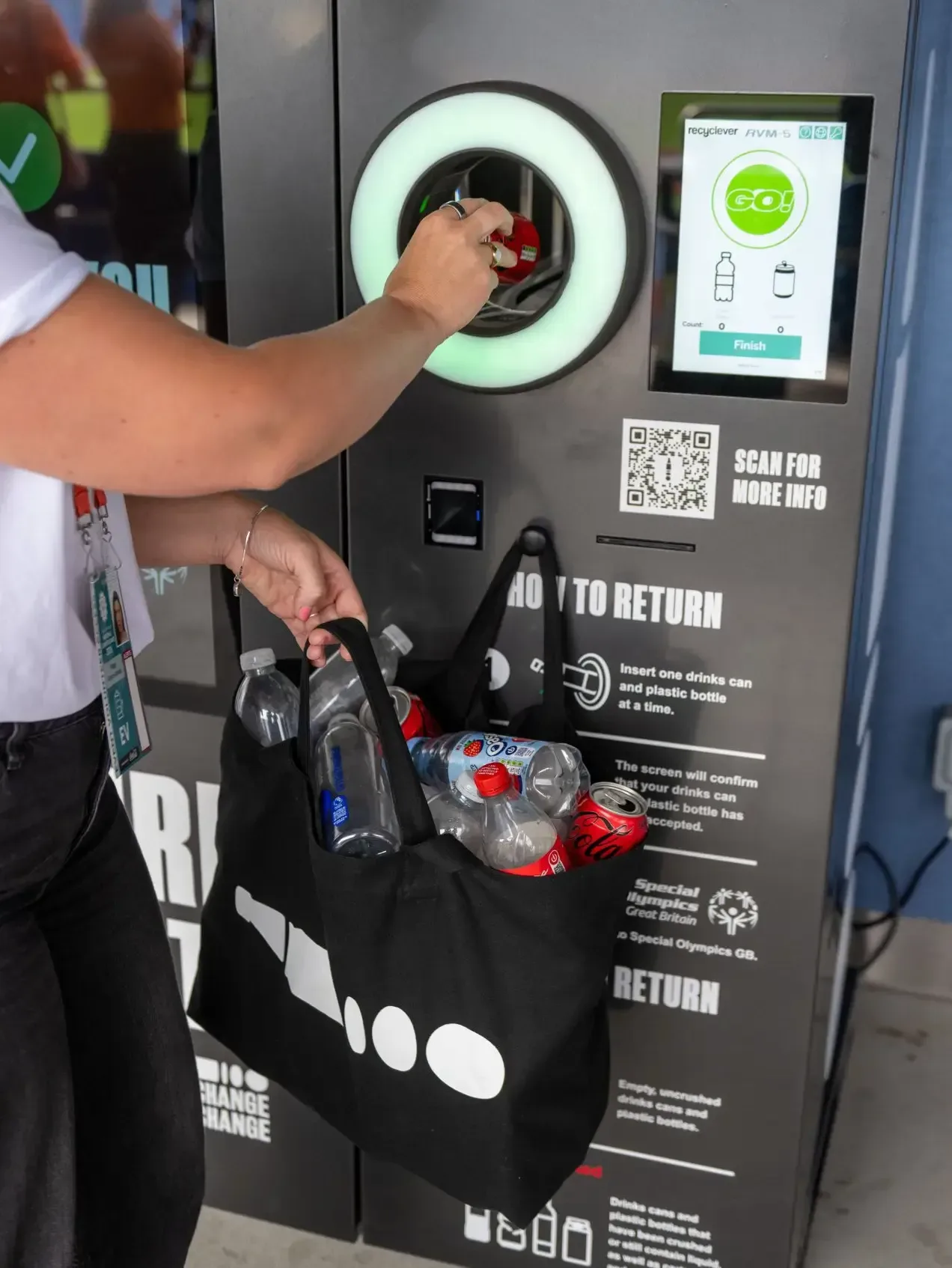
From 1 October 2027, consumers across England, Scotland, Northern Ireland and Wales will pay a 20p deposit when buying drinks in eligible cans and plastic bottles, reclaiming it when the empty container is returned.
Behind that simple consumer proposition sits an enormous exercise in packaging development, technology, logistics, retail infrastructure, data, and consumer behaviour.
For Julian Hunt, an industry-nominated Non-Executive Director at Exchange for Change, the organisation responsible for delivering the scheme, the scale of the transformation should not be underestimated.
“What we have to accept is this is going to be probably one of the biggest changes in a generation when you think of waste and packaging and recycling,” he tells London Packaging Week. “This will be the biggest change that we've seen in the UK since kerbside recycling started. It's on that scale of change.”
From start-up to delivery
At the beginning of 2025, Exchange for Change was effectively a start-up, with no staff, no office, and no IT system. Today, it has a base in Milton Keynes, a leadership team in place, and a workforce of more than 50 people.
“The timetable for delivery of DRS was always going to be challenging, but it's achievable,” says Hunt.
"We had to move from really those very early days of a true start-up to get to where we are now. We've got a team of more than 50 in place, moving rapidly to bring on board the capabilities and the resources that we need to deliver on the operational plan.”
Material specifications have been developed, alongside requirements covering scheme branding and barcodes. Reverse vending machine specifications are progressing, the 20p deposit has been confirmed, criteria for exemptions have been announced, and retail handling fees established to compensate return point operators for the costs involved in participating. Work also continues on the IT and data infrastructure that will connect the system, and on the logistics and counting infrastructure required to collect and process returned material.
Having much of his career at the intersection of food and drink, policy and communications, Hunt is perfectly positioned to support the work of Exchange for Change: he is a former Editor of The Grocer, spent more than a decade at Coca-Cola Europacific Partners, and worked at the Food and Drink Federation. He represents the soft drinks industry through the British Soft Drinks Association.
Hunt opines: “We've tried to make sure that the UK scheme works for everyone, irrespective of whether you're a big retailer or a small retailer, a big hospitality outlet, a small hospitality outlet, a big supplier or a small supplier. This has to work for everyone and it must work for all consumers.”
A year isn't as long as it sounds
For companies waiting for every detail to be settled before acting, Hunt's message is clear: “The primary goal is to make sure you are aware of what's coming and what role you have to play in the delivery of the Deposit Return Scheme.”
He explains: “The responsibility is really on the producers. They will need to work closely in partnership with their suppliers to get ready because there's going to be a lot of work around changing packaging.”
This includes using the correct Exchange for Change branding, appropriate barcodes, and registering products so they can be recognised by the DRS infrastructure and reverse vending machines.
Retailers face different questions: how returns will work within their estates, whether reverse vending machines are required, what equipment is appropriate, and where it can be accommodated.
Then there is transition.
It will be impossible for every non-DRS pack already sitting in warehouses, shops, and consumers’ homes to simply disappear when the scheme begins; Exchange for Change is working with industry and regulators on how stock moves through the system around launch.
Taken together, it means 1 October 2027 is not really the beginning of DRS implementation, as for much of the food, drink, and retail industry, implementation has already begun.
From 2026 readiness to 2027 reality
Those practical questions came under scrutiny at London Packaging Week on Wednesday 16 September, when Hunt took part in ‘DRS countdown: from 2026 readiness to 2027 reality’ on the FMCG stage.
The session brought together voices from across the value chain to assess how ready the system is, identify the most critical gaps to close over the next 12 months and consider what success should look like in its first year. The conversation focused on delivery rather than reopening the debate over policy intent.
“Packaging is a big industry. There are lots of actors, lots of players on all aspects of the scheme, and we've all got a role in trying to connect with all of those operators and help them understand this is coming, this is a reality, and these are the things that you need to do to get ready.”
Exchange for Change already works with more than 50 trade associations and industry bodies, alongside the companies involved in establishing the organisation, to draw input from different parts of the value chain. This includes retailers, wholesalers, soft drinks companies, and brewers.
That breadth inevitably brings competing priorities and as Hunt acknowledges: “You have to get the balance from all of your different stakeholders on some of the key elements of the scheme.”
The UK's combination of dense cities, remote communities and a substantial on-the-go drinks market creates its own operational challenges, as does the size and scale of the UK market.
Exchange for Change has been building relationships with scheme operators across Europe and drawing on their experience, with the Republic of Ireland and Austria among the examples Hunt points towards. Lessons have been learned closer to home too, including from Scotland's previous DRS plans.
“There is a very good network of scheme operators and everybody is very generous with their experience and learnings,” he says. “There's a high-level view of key things you need to do, but there's no plug-and-play operational plan that you can just lift and shift and it will work in every market. Some of the work being done elsewhere is interesting and has been really successful but not on the scale of what's going to be needed for the UK.”
Yet for all the complexity behind DRS, Hunt's definition of success on day one is straightforward: a consumer buys a drink, pays the deposit, enjoys it, returns the empty container, and gets their 20p back.
“Put simply, that is what success looks like from day one.”
Behind that simple measure of success, the deposit must flow correctly through the system, retailers need to be compensated, barcodes must be recognised, data needs to move between different parts of the network, and returned material needs to be collected, counted and recycled. But the consumer should barely notice that complexity.
“If this scheme is to be successful, then the consumer experience from day one has to be right. All the research I've seen says we start from a good place, which is people like the idea and, by and large, are keen to do it.”
Summer 2027 will be critical to achieving this, through marketing and communications to ensure consumers know that DRS is coming and understand what they're doing, why it's important, and what's in it for them.
As Hunt explains: “We've got to make sure it's convenient. We've got to make sure it works. We've got to make sure it's really easy for consumers from day one and then keep improving that experience after go-live.”
This is especially important to achieving the high regulatory collection targets: 70% of containers placed on the market in year one, rising to 80% in year two, and rising to 90% in year three.
“We should never overlook the key to this is also bringing consumers with us.”
Beyond launch day
The ambition of DRS is circularity and recovering substantially more cans and plastic bottles so their materials can be recycled back into new containers, while reducing litter and waste.
This means it will not be a done deal come 1 October 2027. Yes, by the time consumers encounter DRS in the market, much of the industry's work will be in evidence: packs ready, return points working, the logistics network functioning, consumers understanding why they're paying an extra 20p, and how to get it back.
Behind the scenes, implementation will continue. The return network will keep developing, logistics and counting centres will need to scale, and consumer communications will keep driving participation as collection targets increase.
For Hunt personally, October 2027 will mark the end of an unusually long countdown. “Many people know it's been, for me, a 10-year journey. From the earliest policy discussions through Scotland's proposed scheme to the system now approaching launch.
“When 1 October 2027 arrives, I shall have a little party with a Coke Zero or two in a car park of a local store and then really enjoy going to put them in and get my 40p back."
After a decade spent discussing the intricacies of Deposit Return Schemes, it is an appropriately simple ambition.
If millions of consumers can do exactly the same thing just as easily, it may be the clearest indication that DRS is working.
Partner content: this article was originally published by Easyfairs.
Related News
-
Events
London Packaging Week 2026 sets new attendance record
-
Events
UK packaging leaders to discuss DRS readiness at London Packaging Week
-
Sustainability
Special Olympics GB trial tests accessibility of future Deposit Return Scheme
-
Events
PackUK delivers critical EPR updates at London Packaging Week 2026
-
Sustainability
Wimbledon deposit return scheme pilot offers early insight into UK rollout
Advertisement

Latest Packaging News

Grated cheese goes pocket-sized with limited-edition clip-on packaging
Kraft Natural Cheese has introduced Pocket Parm™, a limited-edition miniature version of its grated...
Truly Grass Fed updates packaging in response to consumer preferences
Truly Grass Fed has introduced a refreshed packaging design across its dairy product range, with a...
Miron® introduces refreshed brand identity and website
A new digital experience brings protective glass packaging, expertise, and inspiration together...
Raft of new exhibitors completes the UKPackaging EXPO 2026 line-up
A surge of newly confirmed exhibitors has finalised the floor plan for the highly anticipated...