PHS: Compression strapping machines for corrugated and compressible loads

Supplier News
Some palletised products need to be compressed before they are strapped. This is particularly relevant where the product can reduce in height or volume under pressure, as can be the case with paper and corrugated board products.
A compression strapping machine combines this compression stage with automatic vertical strapping. The load is compressed before the straps are tensioned and sealed, allowing the straps to retain the product in its compressed condition.
What is a compression strapping machine?
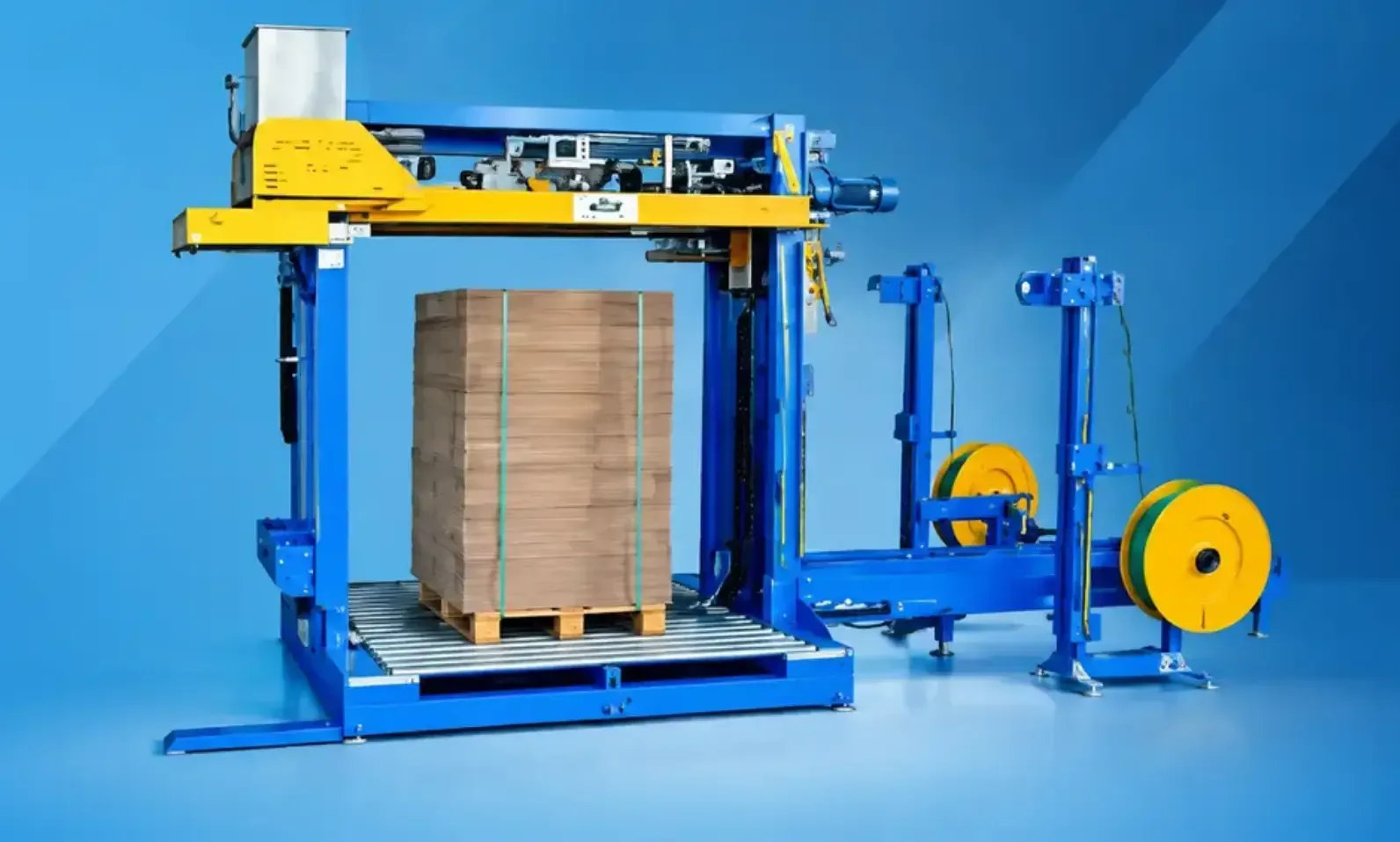
A compression strapping machine combines a press with an automatic strapping system.
Unlike a standard strapping operation where straps are applied to the load as presented, the machine first applies pressure to the product. The vertical straps are then applied while the load is compressed.
The TOSA CMR 045, also referred to as the CAM 45 T2, is designed specifically to vertically strap palletised products that need to be compressed. TOSA identifies the machine for the paper and corrugated board industry.
This makes compression part of the strapping process rather than a separate operation elsewhere on the line.
Why compress a load before strapping?
Compressible products can change dimensions when pressure is applied. If straps are applied before this compression takes place, the final strapped load may not have the same dimensions or condition as a load compressed during the strapping cycle.
A compression strapping system applies pressure first and straps the product while that pressure is being applied.
The requirement for compression therefore depends on the physical characteristics of the product. It isn’t an additional feature required for every palletised load.
Product type, pallet dimensions and the amount of compression required all need to be established when specifying the equipment.
Compression strapping for corrugated board
Corrugated board is one of the applications specifically identified by TOSA for the CMR 045 compression strapping machine.
The machine uses a mechanical top press measuring 1600 × 2000 mm. This applies pressure from above before the vertical strapping operation is completed.
The CMR 045 has two fixed strapping heads and two bayonet groups. This allows two straps to be applied as part of the machine cycle.
For corrugated applications, the specification therefore needs to consider more than pallet dimensions. The characteristics of the stacked product, required compressed height and position of the straps all form part of the system design.
How does automatic compression strapping work?
The exact operating sequence depends on the specified system, but the CMR 045 combines the compression, pallet handling and strapping functions within one machine.
The pallet enters on the machine’s roller conveyor and is positioned for the strapping operation. The mechanical top press applies pressure to the load before the vertical straps are applied and sealed.
TOSA specifies hot-weld strap sealing and powered strap-roll carriage assemblies with strap recovery directly from the roll. The machine is controlled by PLC.
This allows compression and strapping to form part of an automated pallet handling sequence rather than requiring separate manual operations.
Two-strap compression strapping
The number and position of straps are important when specifying a compression strapping system.
The standard CMR 045 configuration uses two fixed strapping heads and two bayonet groups. TOSA specifies an output of up to 112 pallets per hour with two straps.
There are also configuration options for applications requiring different strapping distances. TOSA lists an arrangement using three retractable bayonets and arches with two strapping heads, one of which is movable.
This means the required strap positions should be established from the product and pallet configuration rather than assuming that the same fixed positions will suit every application.
Pallet size and product dimensions
The complete range of products being processed needs to be established before specifying a machine.
For the CMR 045, TOSA gives a maximum pallet size of:
1600 × 1600 × 1800 mm high
The machine’s maximum dimensions are only one part of the specification. Minimum load dimensions, product height before and after compression, pallet format and required strap positions also need to be considered.
Where several products are processed on the same line, Phoenix needs to understand the variation between loads and any changes required between production runs.
Strap specification
The strap specification needs to match the machine and application.
TOSA specifies polypropylene strap at 9/16 × 0.8/1 mm for the CMR 045, with the strap sealed by hot welding.
This differs from some of the other TOSA strapping machines, which is another reason the strap specification should be confirmed for the individual application rather than assumed across the complete machine range.
Where an existing plant already uses a particular strapping material, this should be considered when the new system is specified.
Integrating compression strapping into a production line
A compression strapping machine can form part of a wider automated pallet handling system.
The CMR 045 incorporates a roller conveyor within the machine, while TOSA also offers service conveyors at the entry and exit as optional equipment. A conveyor with a 90-degree turning cross central frame is another available configuration.
The complete installation therefore needs to consider how pallets arrive at the machine, the required compression and strapping sequence and where they travel afterwards.
For existing lines, conveyor height, direction of travel, available floor space and the surrounding equipment should be established before the final layout is determined.
Phoenix Handling Solutions can integrate automatic strapping machines with conveyors and other end-of-line equipment.
Additional equipment for corrugated applications
TOSA offers several optional units for the CMR 045 that are particularly relevant when configuring a system around paper or corrugated products.
- Automatic top cardboard strip dispenser for strips measuring 300 × 800–1200 mm
- Automatic top cardboard dispenser for 300 × 300 mm sheets
- Vertical telescopic strap-guiding channel
- Complete strapping arc
- Entry and exit service conveyors
- 90-degree turning conveyor arrangement
- Alternative bayonet and strapping-head configurations for different strapping distances
These are configuration options rather than standard requirements. The equipment required should be determined from the product, strap positions and overall production-line arrangement.
What needs to be considered when specifying a compression strapping machine?
The starting point is the product and the reason compression is required.
Phoenix will need to understand the pallet and product dimensions, the characteristics of the material being compressed, the required final load condition and the strapping arrangement.
Other important information includes the number and position of straps, production rate, conveyor arrangement, direction of travel, available installation space and the equipment immediately upstream and downstream.
For an existing automated line, drawings, photographs and information about the current operating sequence can also help establish how the compression strapping system needs to be incorporated.
Automatic compression strapping systems
Compression strapping is a specialist process for palletised products that need to be compressed before the straps are applied.
For paper, corrugated board and other suitable compressible products, the machine needs to be specified around both the required compression and the strapping operation. Pallet dimensions, strap positions, production rate and integration with the surrounding handling equipment all need to be considered together.
Phoenix Handling Solutions supplies automatic compression strapping equipment as part of its wider range of horizontal, vertical and compression strapping machines, with installation, commissioning and technical support throughout the UK and Ireland.
View Automatic Strapping Machines
FAQs
What types of products need compression before strapping?
Compression strapping is used where the palletised product can be compressed before the straps are applied. TOSA specifically identifies paper and corrugated board applications for its CMR 045 automatic compression strapping machine.
Is compression strapping the same as vertical strapping?
Not exactly. A compression strapping machine can apply vertical straps, but it also compresses the product before the straps are tensioned and sealed. The compression stage is what distinguishes it from a conventional vertical strapping operation.
Can a compression strapping machine apply two straps in one cycle?
Yes. The TOSA CMR 045 uses two fixed strapping heads and two bayonet groups. TOSA specifies the machine at up to 112 pallets per hour with two straps. Different strapping-distance configurations are also available.
Can the strap positions be changed for different products?
This depends on the machine configuration. TOSA lists an optional CMR 045 arrangement with three retractable bayonets and arches and two strapping heads, one of which is movable to accommodate different strapping distances.
Can compression strapping be integrated with pallet conveyors?
Yes. The CMR 045 incorporates a roller conveyor and can be equipped with service conveyors at the machine entry and exit. The complete system can therefore be configured around the required pallet handling sequence.
What information is needed to specify a compression strapping system?
The main information includes the product being compressed, pallet and load dimensions, required strap positions, number of straps, production rate and conveyor arrangement. For an existing line, the available space and surrounding equipment also need to be considered.
This article was originally published by Phoenix Handling Solutions.

Related News
-
Supplier News
Rowlinson Packaging: The hidden cost of product damage and why industrial packaging matters
-
Supplier News
PHS: Automatic pallet wrapper – A practical assessment checklist
-
Supplier News
PHS: A practical guide to buying industrial pallet wrapping machines in the UK
-
Supplier News
PHS: How strapping machines integrate into end-of-line packaging systems
-
Supplier News
PHS: How to choose an automatic pallet strapping machine
Latest Packaging News

Grated cheese goes pocket-sized with limited-edition clip-on packaging
Kraft Natural Cheese has introduced Pocket Parm™, a limited-edition miniature version of its grated...
Truly Grass Fed updates packaging in response to consumer preferences
Truly Grass Fed has introduced a refreshed packaging design across its dairy product range, with a...
Miron® introduces refreshed brand identity and website
A new digital experience brings protective glass packaging, expertise, and inspiration together...
Raft of new exhibitors completes the UKPackaging EXPO 2026 line-up
A surge of newly confirmed exhibitors has finalised the floor plan for the highly anticipated...