Constantia Flexibles and Evonik win German Packaging Award 2026 for deinking technology

Supplier News
Collaboration recognized for technology that improves the removal of printing inks from flexible plastic packaging during mechanical recycling.
Constantia Flexibles, a producer of flexible packaging for the Consumer and Pharma sector, and specialty chemicals company Evonik have received the German Packaging Award 2026 in the category “Sustainability” for a deinking solution TEGO® Res 1100 for printed flexible plastic packaging.
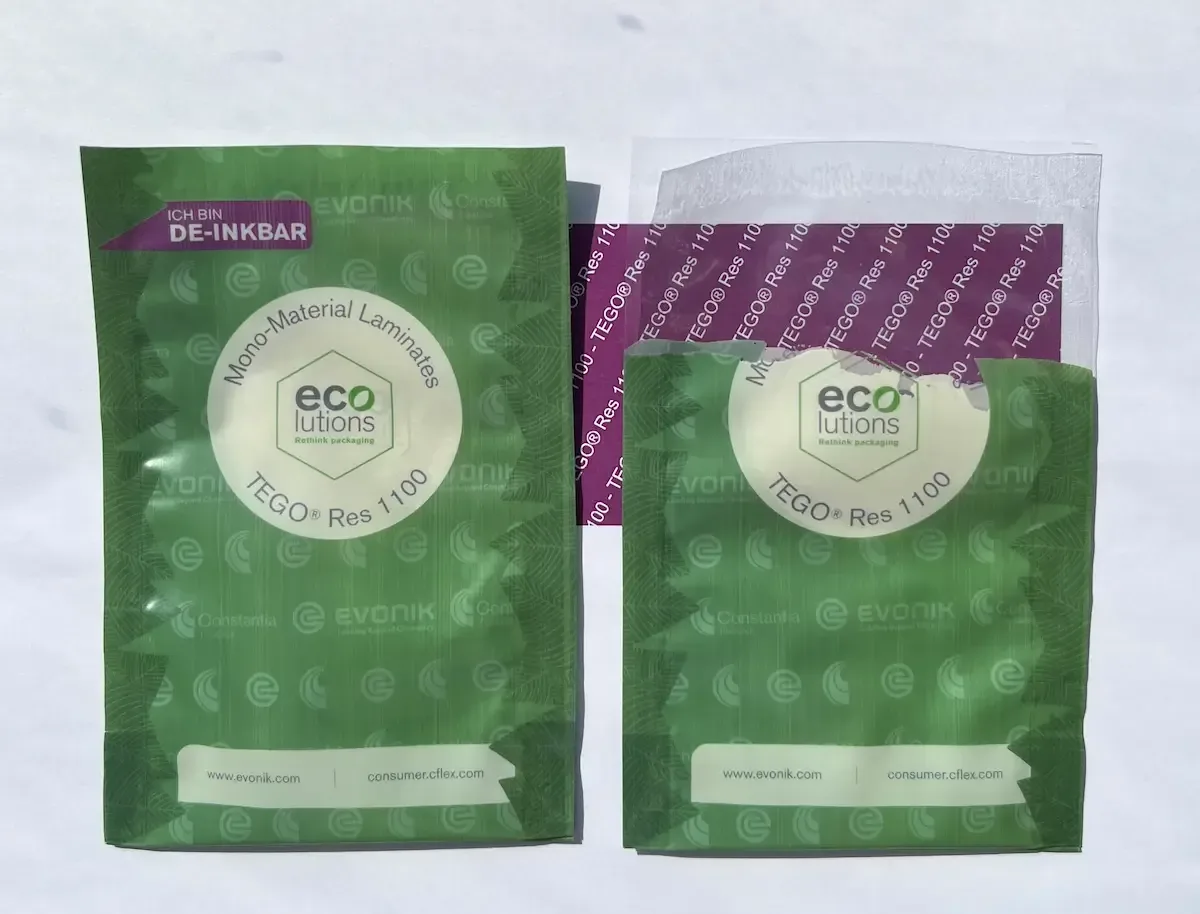
“TEGO® Res 1100 – The Design for Recycling Solution for Printing Inks,” a technology developed by Evonik was evaluated by Constantia Flexibles through testing on a range of flexible packaging laminate structures. It is a co-binder for solvent-based printing inks that supports more effective ink removal during deinking. Integrated directly into existing ink systems, the technology can be implemented without requiring changes to packaging structures or printing processes.
When we talk about recycling, a lot of the discussion focuses on collection and sorting. But material quality matters just as much. Better removal of printing inks can help produce cleaner recyclates and create more options for future applications. Food-contact applications are not there yet and remain subject to separate regulatory and technical requirements. Still, every step that improves material quality matters. We are proud that our joint work with Evonik on this challenge has been recognized with the German Packaging Award.
Stefan Büttner, Vice President Head of CC Polymer Films and Functional Papers, R&D CC Polymer Films at Constantia Flexibles.
For the award submission, Constantia Flexibles used EcoLamPlus, a mono-material polyethylene (PE) laminate from its EcoLam product family. Designed for applications requiring high oxygen and water vapor barrier performance, EcoLamPlus has received an H2R Prequalification Letter and APR Recognition. In the project, the material was printed using white ink formulated with TEGO® Res 1100 to evaluate an approach aimed at improving ink removal during mechanical recycling. Testing showed that key packaging properties, including printability, ink adhesion, seal performance, and abrasion resistance, were maintained. Although EcoLamPlus was used for the submission, the technology can also be applied across a broader range of recyclable film solutions, including the polyethylene-based EcoLam and EcoLamHighPlus structures as well as the polypropylene-based EcoVer, EcoVerPlus, and EcoVerHighPlus products from Constantia Flexibles’ Ecolutions portfolio.
Removing inks effectively from end-of-life packaging is a key step toward achieving a circular economy. The project demonstrates how close cooperation across the value chain can accelerate the development and adoption of packaging solutions designed for a circular economy.
Hendrik Rasch, who is responsible for Circular Packaging and Plastics Recycling in Evonik’s Next Markets Program.
Constantia Flexibles and Evonik have been working together on the project since August 2024. The award will be presented at the German Packaging Award ceremony in November 2026.

Related News
-
Supplier News
Constantia Flexibles brings system-thinking approach to pharmaceutical packaging innovation at PACK EXPO International 2026
-
Supplier News
Constantia Flexibles PERPETUA ALTA among the finalists of De Gouden Noot
-
Supplier News
Constantia Pirk achieves ISCC PLUS certification
-
Supplier News
Financial Times recognizes Constantia Flexibles in Europe’s Climate Leaders ranking
Latest Packaging News

Collectible coffee cans feature characters from Marvel's Avengers: Doomsday
Coffee brand happy has partnered with Marvel Studios to introduce a limited-edition range of...
NIVEA Creme tin now contains 95% recycled aluminium
Novelis and Beiersdorf have announced that the NIVEA Creme tin is now manufactured using 95%...
Syntegon launches Annex 1 Roadshow to bring solutions to pharma customers
Syntegon, a strategic lifecycle partner to the pharmaceutical, biotech, and food industries, has...
Alupro publishes independent econometric review of the UK PRN market
Alupro has released an in-depth econometric analysis of the Packaging Recovery Note (PRN) market,...