Autopack: A complete guide to industrial bucket packaging machines

Supplier News
As demand for packaging automation grows across all industries, manufacturers are increasingly adopting bucket packaging line systems to improve efficiency, consistency and production output.
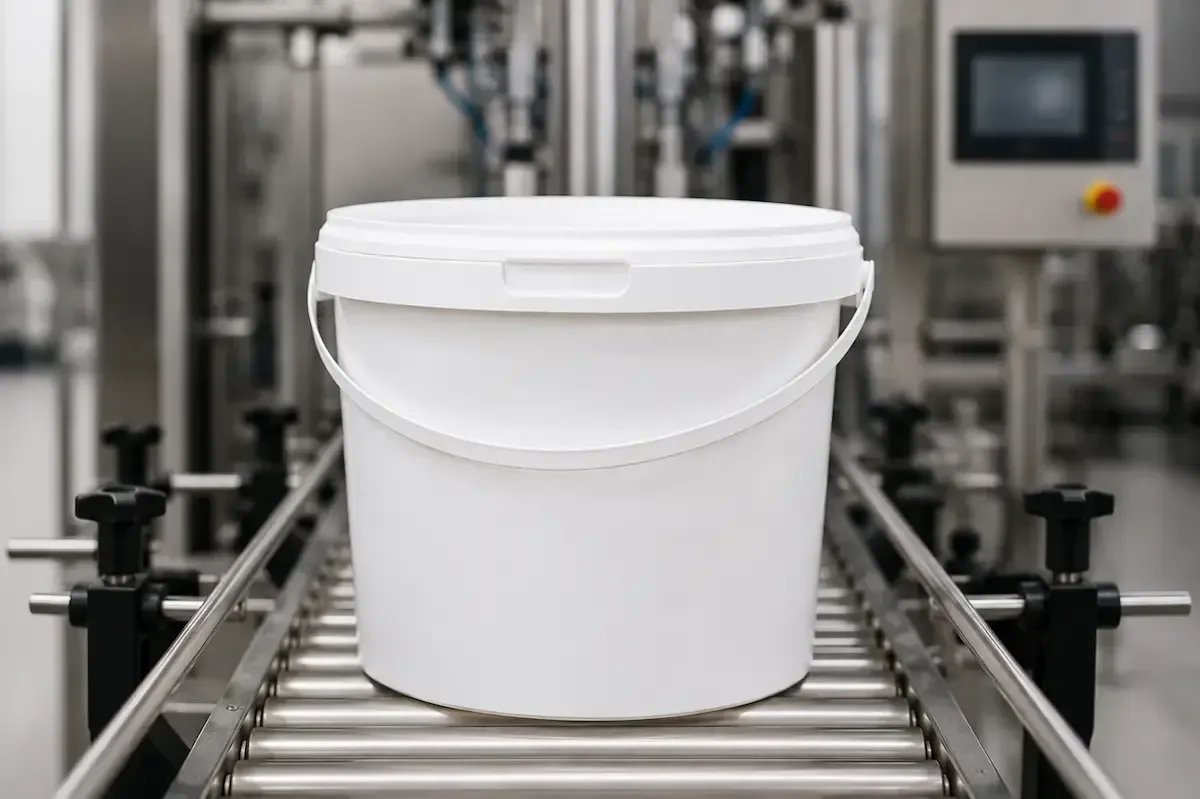
Buckets and pails are commonly used in industries such as food, chemicals, paints, lubricants and construction materials. But what is a bucket line? A bucket line is an automated packaging solution that streamlines the handling and filling of buckets. Depending on the configuration, it can automate the entire process, from bucket denesting and filling to lid placement, sealing and discharge.
What is a bucket line?
A bucket line is a form of integrated packaging where the system’s movement of buckets or pails is automated throughout the various packaging stages. Unlike traditional, standalone machines that can only handle one task of the process, bucket packaging lines are formed from a selection of equipment. These include denesters, fillers, lid placers, sealers and conveyors to create a turnkey product line.
The initial purpose that sparked the popularity of this system was to improve the overall operational efficiency, increase production capacity and both achieve and maintain a consistent quality level. By implementing a full production flow into a single system, handling errors are minimised, labour requirements are lower and your packaging operations will be streamlined.
In simple terms, a bucket line is an effective combination of several automated packaging solutions in one. They are an ideal choice for bulk orders of consistent products.
How does a bucket packaging line work?
Step 1 – Bucket denesting
Part one of the bucket line process starts with denesting. Typically, empty buckets will arrive at the production line stacked within themselves which is crucial for transportation efficiency and to maximise storage throughout the supply chain. A denester will automatically separate and orientate each container before placing them onto the conveyor to start the rest of the process, lowering the need for repetitive manual labour while supporting throughput.
Step 2 – Product filling
Once the buckets themselves have been positioned correctly on the conveyor, they then move to the filling stage. Depending on the product, this may involve anything from a liquid filling system to powder filling equipment, weighing systems or counting systems. Features like dosing valves, auger filler options, linear weighers and even multi-head weighers can also all be integrated.
Bucket filling equipment can be configured for liquids, powders, granules, counted products and weighed products, depending on the application.
Step 3 – Sealing the bucket
After filling, the bucket moves to the sealing stage. Systems may be set up to use film sealing or heat-sealing technology to create a secure closure. Optional gas flushing is another premium feature that can also be incorporated to extend product shelf life where required. Bucket sealers can apply foil or film seals while creating an airtight barrier that helps protect products from contamination.
Step 4 – Lid placement
Following sealing, lids are automatically applied to the buckets. In a similar fashion to bucket denesters, a lid denester is fitted to separate individual lids from the stacks they have been stored in and feed them into the correct position. Automatic lid application equipment then accurately places each lid onto the container, ensuring consistent alignment and preparing the bucket for the final closure stage of the packaging process.
Step 5 – Lid pressing and final packaging
The final stage involves lid pressing to ensure a secure and reliable closure. Lid pressing rollers apply consistent pressure to fully engage the lid with the bucket rim. Autopack’s complete bucket line typically includes lid placement and a lid pressing roller to ensure buckets are securely closed before downstream processes. Once sealed, buckets are ready for labelling, palletising and final distribution.
What machines are included in a complete bucket line?
A complete bucket packaging line consists of several machines that work together to automate the packaging process from start to finish. Every piece of equipment is included to perform a specific function, helping manufacturers improve efficiency, maintain product quality and reduce manual handling throughout production.
Depending on production requirements, a complete bucket line may also include additional automation like labeller machines, case packers, palletisers and pallet wrappers. These automated systems help create a fully integrated packaging solution capable of handling high production volumes efficiently from bucket loading through to final pallet preparation.
What products can be packed on a bucket line?
Bucket packaging lines are a popular option due to their high versatility and innate designs that mean they can handle a wide variety of products across a plethora of industries. Whether you need to package liquids, granules, powders, semi-solids or more, this system can be an ideal choice.
Food products
Bucket lines are widely used within the food industry for packaging products like sauces, olives, dairy products and other ingredients. Automated filling and sealing systems help maintain product quality, improve hygiene standards and ensure accurate fill volumes for both retail and bulk food applications.
Chemicals
Chemical manufacturers use bucket packaging lines for products including paints, lubricants and industrial liquids. These systems provide reliable filling accuracy and secure sealing, helping to reduce waste while ensuring products remain safely contained during storage, transportation and use in demanding industrial environments.
Home care products
Varying home care products are another, major application for bucket packaging lines, particularly when it comes to cleaning chemicals and detergents. Automated systems can handle a variety of product viscosities while consistently delivering filling performance. This helps manufacturers achieve high production volumes while maintaining product integrity and packaging quality.
Personal care products
One of the other primary sectors that make frequent use of bucket packaging lines are personal care products. Whether it be creams or cosmetic ingredients. The precision filling technology that can be implemented throughout is key for ensuring consistently accurate dosing, without any added physical labour.
The benefits of automating bucket packaging
Increased production speed
One of, if not the most important benefit of automated bucket packaging is the increased production speed throughout the process. Automated bucket lines enable continuous operations with minimal interruptions. This allows any manufacturer higher throughput at a far higher, consistent quality.
Improved accuracy
Automated bucket packaging systems improve accuracy by delivering consistent fill weights across every container. This reduces product giveaway, minimises waste and ensures packaging specifications are met. Greater precision also supports quality control objectives while helping manufacturers maximise product yield and operational efficiency.
Better workplace safety
Safety ratings are important in any industry, and by implementing automation into bucket packaging lines means that manual handling, spillages and the risk of strain-related injuries is greatly lowered. Automation reduces physical demands on operators by transferring bucket movement, filling and handling processes to machinery.
Improved hygiene
Automated bucket lines support hygienic production by reducing direct human contact with products and packaging. Hygienic machine designs further enhance cleanliness standards. Autopack’s bucket-handling equipment is designed for machinery not to touch the bucket’s internal surfaces, supporting hygienic production environments.
Lower labour costs
Automation can go a long way to reduce labour costs by reallocating employees from repetitive manual tasks to higher-value activities. Improved productivity and operational efficiency mean fewer resources are required for routine packaging functions, helping manufacturers optimise workforce utilisation while maintaining high production output.
Scalability
Automated bucket packaging systems offer excellent scalability for growing businesses. Manufacturers can begin with semi-automatic equipment and expand to fully automated solutions as demand increases. Here at Autopack, our modular bucket line approach allows additional equipment to be integrated as production requirements evolve over time.
Should you choose a semi-automatic or fully automatic bucket line?
Semi-automatic bucket lines
Semi-automatic bucket lines are often the more ideal option for SMEs, businesses with lower production volumes or companies at the beginning of their automation journey. These more basic systems combine manual and automated processes, offering a practical entry point into automated packaging.
Some key advantages include lower upfront investment costs, far easier implementation, reduced operational complexity and the flexibility in production scalability.
Fully automatic bucket lines
Fully automatic bucket lines, as an option, are best suited to high-volume manufacturers, facilities operating multiple shifts and large-scale production environments. These systems are typically designed to automate the entire packaging process with minimal operator intervention.
Some of the many benefits include maximum efficiency levels, higher throughput rates, greater consistency, reduced labour requirements and improved productivity, making them ideal for businesses seeking long-term operational optimisation.
How to choose the right bucket packaging equipment
Once you know what a bucket line is and how it can support your processes, selecting the right bucket packaging line equipment requires an understanding of your product and production requirements. Certain factors like product type, bucket size and required production speed will influence the machinery and level of automation needed. It is also important to consider future growth plans, ensuring your equipment can scale alongside increasing demand.
Industry regulations, particularly within food, chemical, home care and personal care sectors, may impact machine design and hygiene requirements. Businesses should also assess how new equipment will integrate with existing production lines. By consulting experienced packaging specialists, like the experts here at Autopack, can help identify the most efficient and cost-effective solution for long-term success.
Why work with Autopack for bucket packaging machinery?
Autopack provides complete bucket packaging machinery solutions designed to meet the needs of manufacturers across a wide range of industries. From complete line integration and bespoke project management to installation, commissioning and ongoing servicing, our experts will provide you with comprehensive support throughout every stage of a project.
Whether you are looking for automatic and semi-automatic solutions, we can create a package for businesses with selected equipment that aligns with their production requirements and budget. With extensive experience across food, chemical, home care, personal care and various other manufacturing sectors, Autopack supplies complete packaging systems while delivering customised machinery integration tailored to specific operational needs.
How a bucket line can transform your packaging operation
This blog post has filled you in on what a bucket line is and how a bucket packaging line provides an efficient way to automate the filling, sealing, lidding and general handling of bucket-based products. By combining machinery like bucket denesters, filling systems, sealers, lid applicators, conveyors and end-of-line equipment, manufacturers can improve productivity, accuracy, safety and hygiene.
If you are looking to streamline your bucket packaging process, speak with Autopack to explore a tailored solution designed around your products, production goals and facility requirements. Contact our experts today on 01432 677 000 or email info@auto-pack.co.uk to discuss your needs.
This article was originally published by Autopack.

Related News
-
Supplier News
Autopack: What is a sealing machine and how does it work?
-
Supplier News
Autopack Group launches new division Autoweigh at PPMA Show with smallest ever multihead weigher
-
Supplier News
PPMA Show sees a full packaging line-up and new division from Autopack
-
Supplier News
Autopack Group’s Technosys helps leading pork scratchings producer rebuild production after fire
-
Supplier News
Autopack and Weightpack link-up to provide advanced net weight filling systems to UK manufacturers
Latest Packaging News

Grated cheese goes pocket-sized with limited-edition clip-on packaging
Kraft Natural Cheese has introduced Pocket Parm™, a limited-edition miniature version of its grated...
Truly Grass Fed updates packaging in response to consumer preferences
Truly Grass Fed has introduced a refreshed packaging design across its dairy product range, with a...
Miron® introduces refreshed brand identity and website
A new digital experience brings protective glass packaging, expertise, and inspiration together...
Raft of new exhibitors completes the UKPackaging EXPO 2026 line-up
A surge of newly confirmed exhibitors has finalised the floor plan for the highly anticipated...